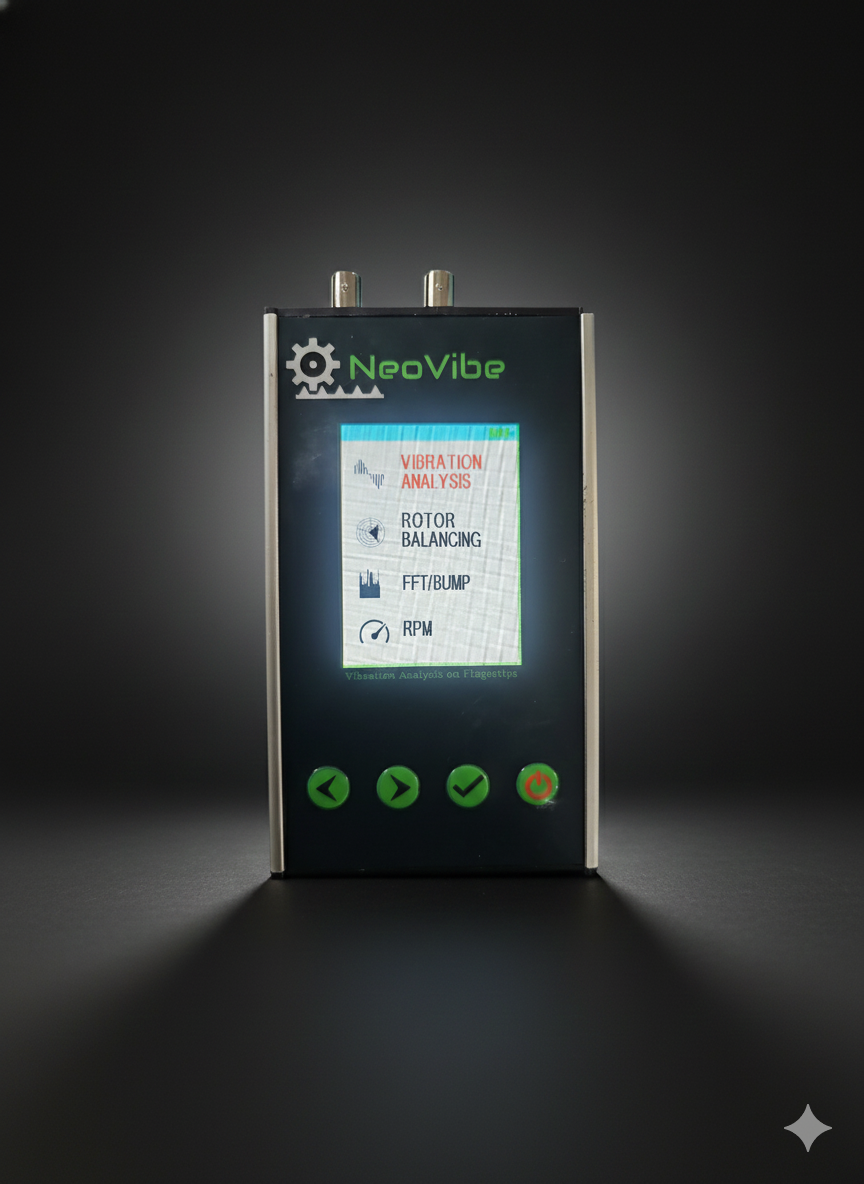
Wireless Vibration Sensor
Advanced 3-axis vibration monitoring with FFT analysis for predictive maintenance. LoRaWAN wireless connectivity for rotating machinery monitoring and health diagnostics.
Product Overview
The Controlytics Wireless Vibration Sensor is an advanced condition monitoring device designed for predictive maintenance applications on rotating machinery and critical equipment. With integrated 3-axis MEMS accelerometer technology, this sensor captures vibration data in three spatial dimensions, enabling comprehensive equipment health assessment.
Built-in FFT (Fast Fourier Transform) analysis identifies fault frequencies and anomalies that indicate bearing degradation, misalignment, imbalance, and other mechanical issues before catastrophic failure. LoRaWAN connectivity enables wireless deployment across facilities without the expense of wired sensor networks. The magnetic mount and IP67 enclosure provide versatility for various mounting scenarios on motors, pumps, fans, compressors, and other rotating equipment.
Key Features
How It Works
Vibration Capture: The 3-axis MEMS accelerometer continuously samples vibration motion in X, Y, and Z axes at 3.2 kHz sample rate covering 2 Hz - 8 kHz frequency range.
Signal Processing: The onboard DSP performs FFT analysis on buffered acceleration data to generate frequency domain spectra. RMS and peak acceleration metrics are calculated.
Anomaly Detection: Machine learning algorithms detect abnormal vibration patterns and fault signatures. Alerts trigger when severity thresholds are exceeded.
Wireless Transmission: FFT spectra, RMS values, and alerts are encrypted and transmitted via LoRaWAN. Historical data stored locally for offline analysis.
Predictive Analysis: The Controlytics platform correlates sensor data across equipment fleets, predicting maintenance windows and optimizing service scheduling.
Technical Specifications
| Parameter | Specification |
|---|---|
| Measurement Type | Acceleration (3-axis), Velocity, Displacement |
| Accelerometer Type | MEMS dual-axis, ±16g range |
| Frequency Range | 2 Hz to 8 kHz (-3dB bandwidth) |
| Frequency Resolution | 0.5 Hz (3200 point FFT) |
| Sample Rate | 3.2 kHz per axis |
| Acceleration Range | ±16g (±157 m/s²) selectable sensitivity |
| Acceleration Accuracy | ±5% of full scale |
| Velocity Range | 0-500 mm/s (calculated from acceleration) |
| Displacement Range | 0-100 mm (calculated from acceleration) |
| Analysis Features | FFT, RMS, Peak, Peak-to-Peak, Crest Factor, Kurtosis |
| Fault Detection | Bearing wear, imbalance, misalignment, looseness detection |
| Data Update Rate | Configurable: every minute to hourly |
| Wireless Technology | LoRaWAN Class A/B/C |
| Frequency Bands | 868 MHz EU, 915 MHz US, 923 MHz AS, 470-510 MHz CN |
| Range (Open Environment) | Up to 10 km line-of-sight |
| Transmit Power | 20 dBm (100 mW) |
| Receiver Sensitivity | -140 dBm |
| Security | AES-128 encryption, LoRaWAN 1.1 secure join |
| Power Source | 2 x AA Lithium batteries (3.6V total) |
| Battery Life | 3-4 years (typical, hourly FFT transmission) |
| Current Consumption | Sleep: 5 µA; Processing: 35 mA; TX: 140 mA; RX: 15 mA |
| Enclosure Material | Die-cast aluminum with epoxy coating; stainless steel magnet |
| Enclosure Rating | IP67 (dust-tight, temporary submersion) |
| Operating Temperature | -40°C to +85°C (device); -40°C to +100°C (accelerometer) |
| Storage Temperature | -50°C to +100°C |
| Vibration Environment | Can operate on equipment with continuous vibration up to 20g |
| Dimensions | 60 x 60 x 80 mm (compact cylindrical) |
| Weight | 245 grams |
| Mount Type | Neodymium magnetic mount (grip force 45 lbs) |
| Certifications | CE, FCC, RoHS, LoRaWAN Alliance Certified, ISO 20816 compliant |
Fault Detection Signatures
| Fault Type | Vibration Signature | Detection Method |
|---|---|---|
| Bearing Degradation | High-frequency impacts in 5-20 kHz range | Envelope analysis, kurtosis trending |
| Imbalance | Dominant peak at 1x running speed | FFT peak tracking, amplitude trending |
| Misalignment | Strong peaks at 1x and 2x running speed | Harmonic pattern recognition |
| Looseness | Broad spectrum increase, multiple harmonics | RMS trending, spectral width analysis |
| Belt/Pulley Issues | Peak at belt frequency and harmonics | FFT identification of belt frequencies |
| Friction Rubbing | Noise floor increase, broadband elevation | Overall RMS increase, spectral flatness |
Industry Applications
The Wireless Vibration Sensor enables predictive maintenance across industrial equipment, reducing downtime and extending asset lifespan by identifying mechanical issues before failure occurs.
Downloads & Documentation
Predict Equipment Failures Before They Happen
Deploy wireless vibration monitoring across your critical equipment. Reduce unplanned downtime and extend asset lifespan with predictive maintenance insights.