One platform. Twenty-four models. Your exact part number in four clicks.
Two radars to choose from: a 24.15 GHz K-Band Doppler radar that measures every approaching vehicle at up to 200 metres and ±1 km/h, or the CAIPL/R/200 - Multilane 60 GHz / 77 GHz MIMO + DBF radar that tracks up to 32 vehicles across several lanes at once. An ultra-bright LED sign then shows the driver their own speed — green below your threshold, red above it. Choose the digit size, the power source and the accessories, and the builder below returns the model number, the full specification and the Bill of Quantities.
Speed limits posted on a static board get ignored.
A painted sign tells a driver what the limit is. It does not tell them what they are actually doing — and most drivers genuinely do not know. A display that reacts to the individual vehicle closes that gap in the one second that matters.
No feedback, no correction
Static signage is background noise on a route someone drives daily. Nothing on the road changes when a particular driver goes too fast, so nothing about their behaviour changes either.
No record of what happened
Without measurement there is no baseline. You cannot show that a stretch of road has a speeding problem, or prove that an intervention fixed it, from anecdote alone.
Enforcement is expensive
Stationing people to catch over-speeding does not scale across a plant campus or a highway corridor, and it only works while someone is standing there.
Detect, display, alert, record.
Detect
The CAIPL/R/200 Doppler head picks up the nearest approaching vehicle at up to 200 m and measures its speed to ±1 km/h, with a response time configurable from 50 to 2,000 ms. For multi-lane roads, the optional CAIPL/R/200 - Multilane 60 GHz / 77 GHz MIMO + DBF radar tracks up to 32 vehicles at once.
Display
The speed appears on ultra-bright multicolour LEDs rated at 7,500 mcd or more — readable from 300 m in direct sunlight and at night. Green under your threshold, red over it.
Alert
On buzzer builds an audible over-speed alarm sounds at the sign, which reaches pedestrians and site staff as well as the driver.
Record
On-device logging keeps time-stamped speed records locally. ANPR builds go further and capture the plate, speed and timestamp of every violation to a cloud dashboard.
Build your model
Four choices define every unit in this range. Make them and you get the exact part number, the full specification and the Bill of Quantities — ready to copy, email, or send to your WhatsApp.
Full specification
Figures from the CAIPL datasheets. The detection core is identical across both families — only the display differs.
| Parameter | 2-Digit12" · 1F1F | 3-Digit16" · 1.5F2F |
|---|---|---|
| Display | ||
| Digit height | 12 inches (304.8 mm) | 16 inches (406 mm) |
| LED viewable area | 320 × 320 mm | 640 × 480 mm |
| Casing size (L × W) | 630 × 380 mm | 840 × 700 mm |
| Displayable speed | 1–99 km/h (2-digit ceiling) | 1–240 km/h (full radar range) |
| LED type | Ultra-bright discrete-segment LEDs — multicolour, ≥ 7,500 mcd | |
| Visibility | ≥ 300 m, readable in direct sunlight and at night | |
| Colour-coded alerts | Green at safe speed, red on over-speed — threshold user-configurable | |
| Message / text display | Pre-programmed or personalised 1–2 line text, emoji, warning signs, graphics | |
| Radar detection — CAIPL/R/200 | ||
| Type / frequency | Doppler K-Band, 24.15 GHz CW — or the CAIPL/R/200 - Multilane 60 GHz / 77 GHz MIMO + DBF multi-lane radar (add-on, tracks up to 32 vehicles) | |
| Measurement range | 1–240 km/h at ±1 km/h | |
| Detection range | 200 m | |
| Direction detection | Approaching, leaving, or both (dual direction) | |
| Response time | 50 ms – 2,000 ms, configurable | |
| Sensor power / temp. | 9–24 V DC (typ. 12 V), ≤ 1.2 W · −20 °C to +85 °C | |
| Add-on radar — CAIPL/R/200 - Multilane | ||
| Type | MIMO + DBF multi-lane speed radar | |
| Frequency | 60 GHz or 77 GHz | |
| Coverage | Multi-lane speed detection — one radar covers several lanes | |
| Simultaneous tracking | Up to 32 vehicles | |
| Availability | Optional add-on on every model, in place of the standard CAIPL/R/200 | |
| Enclosure, power & comms | ||
| Casing material | Mild steel (MS), powder-coated, black | |
| Protection rating | IP65 | IP65 unit; IP66 radar |
| Mounting | Pole-mountable | Pole-mountable; one unit per lane, or one multi-lane radar across several lanes |
| Power supply | 230 V AC mains, or 24 V DC off-grid solar via MPPT controller and battery bank | |
| Solar array (no ANPR) | 250 W · 20 A MPPT · 65 Ah | 350 W · 40 A MPPT · 100 Ah |
| Solar array (with ANPR) | 550 W · 40 A MPPT · 150 Ah LiFePO₄ — IP66 on both families | |
| Electrical protection | Reverse-voltage protection, short-circuit protection | |
| Communication | Ethernet and Wi-Fi | |
Detection distance and accuracy are manufacturer-rated under nominal conditions; field performance depends on target size, weather and installation geometry. The ±1 km/h figure assumes travel aligned with the radar boresight — an angled installation introduces cosine error that should be accounted for during site planning.
The two choices that change the most
Everything above is common to the range. These two decide what the system can actually do for you — and where you can put it.
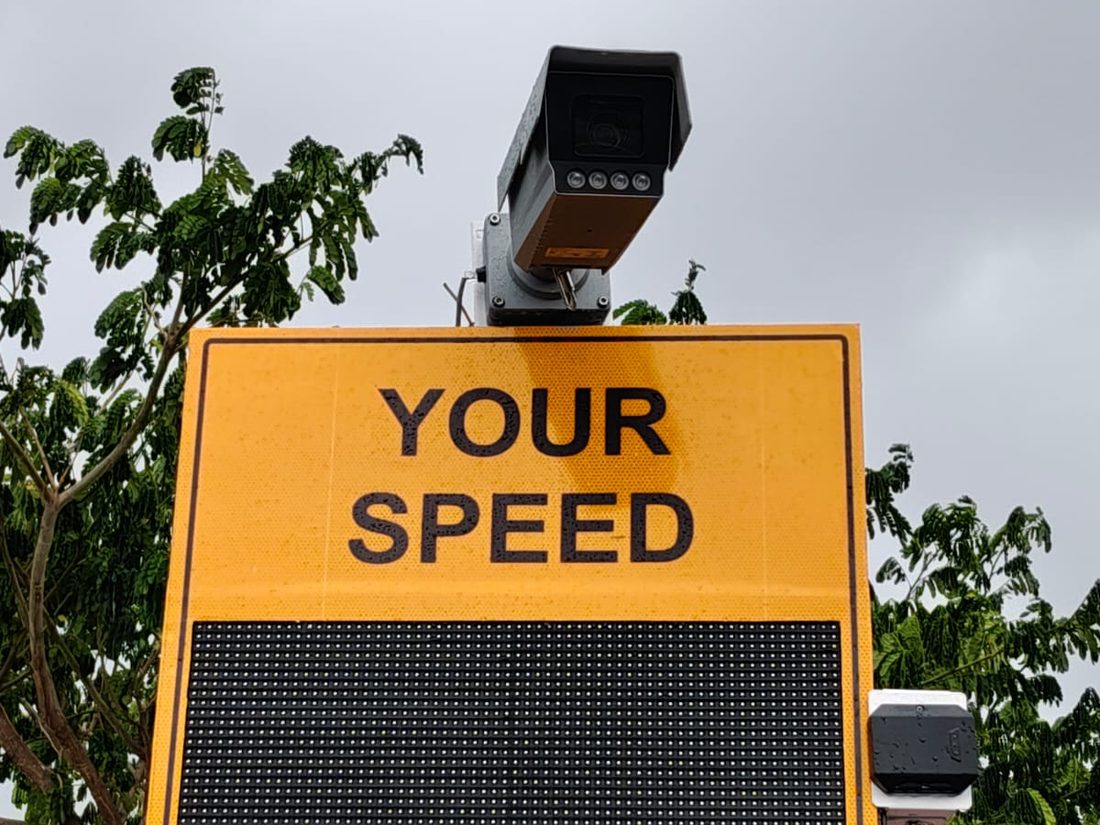
ANPR camera — from deterrent to evidence
A speed display changes behaviour. An ANPR build also proves what happened, which is what turns a safety measure into something you can enforce and report on.
- 4MP IP enforcement camera, 2688 × 1520 at 30 fps
- 10–50 mm motorised varifocal lens, 30 m infrared night vision
- IP67 / IK10 rated camera housing
- Local Processing Unit — 8 GB RAM, 256 GB or 512 GB storage
- Time-stamped plate, speed and image for every violation
- Vehicle counts, average and maximum speeds synced to a multi-site cloud dashboard
- Adds the
/ANPRsuffix; replaces the need for on-device logging
Full camera, LPU & software specifications
- Camera type
- 4MP IP ANPR enforcement camera, LPU-linked
- Sensor
- 1/1.8" 4MP CMOS — 2688 × 1520 @ 25/30 fps
- Recognition
- Number plate, vehicle type, colour and logo; camera-side speed estimation to 180 km/h
- Low light
- 0.0001 Lux min.; 4 × 850 nm IR LEDs to 30 m
- Imaging
- True WDR 140 dB, 2D/3D noise reduction, defog
- Power
- 12–36 V DC or PoE, ≤ 13 W
- Interfaces
- RJ-45, MicroSD ≤ 512 GB, NAS/SFTP, RS-232 ×2, RS-485 ×2, 3 alarm-in / 2 relay-out
- Temperature
- −40 °C to +65 °C
- LPU
- Multi-core industrial embedded processor, 8 GB RAM, 256 GB or 512 GB storage, Linux, in an outdoor cabinet with PoE switch, shared supply and cooling
- Local software
- Processes radar and video in real time, drives the display, stores records locally through network interruptions, forwards when connectivity returns
- Central software
- Multi-site dashboard, average and maximum speed, vehicle counts both directions, report extraction and charting, storage to 1 million vehicle records, remote configuration
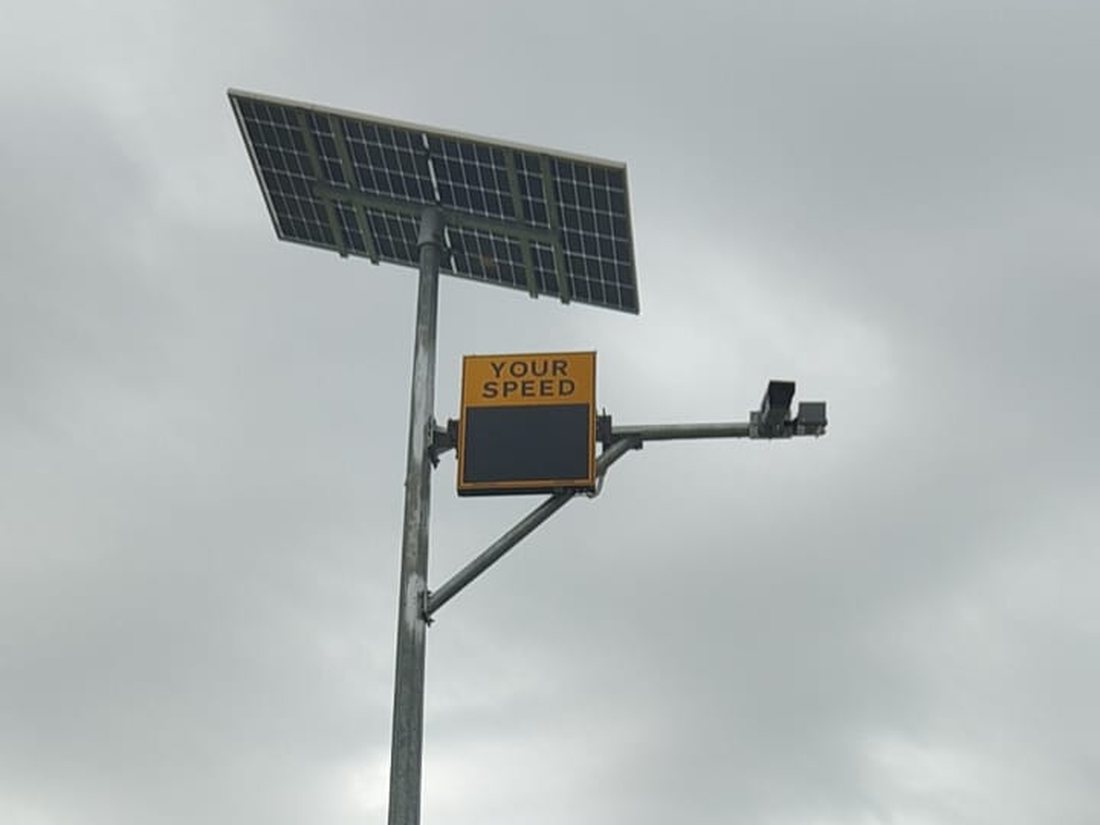
Off-grid solar — put it where the problem is
The right spot for a speed display is rarely the spot with a power point. A solar build removes that constraint entirely, with no trenching and no mains run.
- Mono-crystalline panel, MPPT charge controller, LiFePO₄ battery bank
- 2-Digit without ANPR — 250 W panel, 20 A MPPT, 65 Ah battery
- 3-Digit without ANPR — 350 W panel, 40 A MPPT, 100 Ah battery
- Any family with ANPR — 550 W panel, 40 A MPPT, 150 Ah battery
- Array is sized to the load, so the camera upsizes it on both families
- Pole-mounted alongside the sign; no civil work for the display itself
- Uses the
Spower code in place of230
Sized for continuous day/night operation. Actual autonomy varies with local irradiance, panel orientation and shading, so we size the array against your site rather than a catalogue figure.
See it working
Product walkthroughs and real installations. View the full playlist ↗
Radar Products Introduction
How the range works, end to end.
Major Installations So Far
Deployments across highways, facilities and communities.
Speed Detection Demo
Green through the limit, red past the threshold.
What engineers and procurement teams ask
What is the difference between the 2-Digit and 3-Digit radar speed displays?
The 2-Digit model has 12 inch digits in a 630 × 380 mm casing and can display speeds from 1 to 99 km/h, which suits urban roads, campus gates and school zones. The 3-Digit model has 16 inch digits in an 840 × 700 mm casing and displays the radar's full 1–240 km/h range, for highways, expressways, arterial roads and haul roads. The radar itself is identical on both — only the display differs.
How far away can the radar detect a vehicle, and how accurate is it?
The integrated CAIPL/R/200 sensor is a 24.15 GHz K-Band CW Doppler radar. It detects vehicles at up to 200 metres and measures 1–240 km/h to ±1 km/h, with a response time configurable from 50 to 2,000 ms. The ±1 km/h figure assumes the vehicle's direction of travel is aligned with the radar boresight; an angled installation introduces cosine error that should be accounted for during site planning.
Can one radar cover multiple lanes?
Yes. The CAIPL/R/200 - Multilane is available as an add-on in place of the standard single-lane CAIPL/R/200 head. It is a 60 GHz / 77 GHz MIMO + DBF (digital beam-forming) multi-lane speed radar that measures speed across several lanes at once and tracks up to 32 vehicles simultaneously. It fits every model in the range; select it in the model builder and it is added to the specification and Bill of Quantities.
Can the radar speed display run without mains power?
Yes. Every model is available as an off-grid solar build with a mono-crystalline panel, MPPT charge controller and LiFePO₄ battery bank sized to the model: 250 W / 20 A / 65 Ah for 2-Digit, 350 W / 40 A / 100 Ah for 3-Digit, and 550 W / 40 A / 150 Ah for any build carrying an ANPR camera. No trenching or mains run is required.
What does the ANPR option add?
The ANPR bundle adds a 4MP IP enforcement camera (2688 × 1520 at 30 fps, 10–50 mm motorised varifocal, 30 m infrared night vision, IP67/IK10) and a Local Processing Unit with 8 GB RAM and 256 GB or 512 GB storage. Together they capture a timestamped number plate for every violation and sync vehicle counts, average and maximum speeds to a central cloud dashboard covering multiple sites. It turns a deterrent into evidence.
How is the display mounted and how visible is it?
Both families are pole-mountable with bracket kits for the display and the radar, and install on existing light poles or signage posts without civil work. The ultra-bright multicolour LEDs are rated at 7,500 mcd or more and are readable from 300 metres in direct sunlight and at night. Speeds show green below your configured threshold and red above it.
How is a model identified, and how do I name the right one?
Every model is defined by four choices spelled out in the part number: digit family (2DR or 3DR), power source (230 for mains or S for solar), accessories (a buzzer, an ANPR camera, both or neither), and whether on-device data logging is fitted. The accessory slot reads R with no buzzer, B with one, and gains a D when local logging is fitted — so R, B, RD or BD — while an ANPR camera adds an /ANPR suffix. For example CAIPL/3DR/S/BD/1.5F2F is a 3-Digit, solar-powered unit with a buzzer and on-device logging. The builder above returns the exact model number and a full Bill of Quantities.
Why are there 24 models and not 32?
On-device logging is not offered on ANPR builds. The Local Processing Unit already records the plate, speed and timestamp of every violation and syncs them to the cloud dashboard, so a separate on-device logger would be redundant. That removes the eight D+ANPR permutations, leaving 24. The builder hides the logging option when ANPR is selected, but remembers your choice so unticking ANPR restores it.
Ready to deploy this system?
Build your model above for an instant part number and Bill of Quantities, or talk to an engineer about site planning, mounting geometry and lane coverage.